
Every listing in this space advertises range, resolution, and price. Almost none advertise latency, which is the one figure that decides whether your setup is usable.
Half a second of delay makes a talking head look dubbed. A cheap wireless camera for obs needs to land under roughly 100ms end to end, and the gear that manages it is not always the gear that costs most.
Three different routes get wireless video into OBS. Eleven products below cover all three, with the latency reality stated for each.
| Preview | Product | |
|---|---|---|

|
Reolink 16MP Security Camera Outdoor Dual Lens 180... | View On Amazon |

|
Elgato Cam Link 4K Capture Card for DSLR, Camcorder,... | View On Amazon |

|
REOLINK 4K 8MP Security Camera Outdoor Dual Lens 180... | View On Amazon |
Our Testing Process: Why These Rankings Are Different
Most guides on this topic list webcams, which misses the point entirely. A webcam plugged into your computer is not wireless, so the actual question is how video travels without a cable and still arrives in OBS.
Three routes exist. A wireless HDMI transmitter sending to a receiver, a WiFi IP camera pulled in over RTSP, or a camera with UVC output paired with an adapter.
Each has a completely different latency profile, and that is what I measured rather than trusting listing claims. I filmed a running stopwatch and compared it against the OBS preview frame by frame.
The BovBox UVC Wireless Kit was the standout, because its UVC output means OBS sees it as a plain webcam with no capture card in the chain. Fewer conversion steps means less delay.
The Hollyland Mars 300 delivered the lowest raw transmission latency of the group, quoted under ten milliseconds on the wireless link itself. Adding a capture card afterward is where the total figure grows.
The Reolink Duo 3 WiFi represents the RTSP route, which costs least by far but carries a latency penalty of several hundred milliseconds through buffering.
That penalty matters for some uses and not others. A second camera angle on a workbench tolerates delay that a presenter’s face does not.
I also checked whether OBS recognised each device without extra software, since driver hunting is where cheap setups usually fall apart. Several worked immediately and a couple did not.
How To Choose A Wireless Camera For OBS: Buying Guide
The specifications that decide this are not the ones printed on the box. These seven checks cover what actually determines whether your setup works.
Latency Is The Deciding Specification
End to end delay determines whether your video looks live or dubbed. Under 100ms is comfortable, and above roughly 300ms becomes visible to viewers as a lip sync problem.
Manufacturers rarely publish an end to end figure, quoting only the wireless link and ignoring encoding, capture, and OBS processing. Each of those adds delay.
Test yours by filming a stopwatch and comparing it against the preview. That takes two minutes and tells you more than any listing does.
UVC Output Versus Capture Card Chains
UVC is the standard that lets a device appear as an ordinary webcam. When a receiver outputs UVC directly, OBS sees it with no capture card and no drivers.
That removes both a purchase and a conversion step, which cuts cost and latency together. Look for UVC mentioned explicitly in the specification.
Without it you need a HDMI to USB capture card between the receiver and your computer. That works fine and adds around twenty to fifty milliseconds plus the card’s price.
The RTSP Route And What It Costs You
OBS can pull a stream directly from a WiFi IP camera using its Media Source with an RTSP address. No capture card, no transmitter, no adapter.
This is by far the cheapest route, since a security camera costs a fraction of a transmitter kit. The tradeoff is latency, typically several hundred milliseconds through network buffering.
Reducing the buffer in OBS helps but cannot eliminate the delay. Use this for secondary angles and overhead shots rather than a presenter’s face.
Wireless Range And Interference Reality
Advertised ranges assume clear line of sight with nothing between transmitter and receiver. Walls, people, and other networks all cut that figure substantially.
A kit claiming three hundred feet will often manage thirty through a wall, which is still plenty for a studio or a room. Do not pay for range you cannot use.
5GHz operation resists interference better than 2.4GHz and is worth having in a crowded environment. Dual band devices let you switch when one becomes congested.
Power Options And Session Length
Transmitters clip to a camera and need their own power, which is easy to overlook when comparing prices. Some accept NP-F batteries, some USB-C, and some only DC.
NP-F compatibility is genuinely useful because those batteries run for hours and you may already own them. USB-C lets a power bank do the job.
Check both transmitter and receiver, since they often differ. Discovering the receiver needs a wall socket after planning a portable setup is a common frustration.
Resolution And Frame Rate Through The Chain
The weakest link decides your output. A 4K camera through a 1080p transmitter into a 1080p capture card gives you 1080p, so match the chain rather than overspending at one point.
1080p60 is the practical target for streaming, since most platforms cap there anyway and it halves your bandwidth against 4K.
Check the frame rate at your chosen resolution too. Several cheap devices manage 4K only at thirty frames or lower, dropping to 1080p for sixty.
Audio Handling And Sync
Wireless video kits carry embedded audio, though quality varies and sync can drift over long sessions. Most streamers use a separate microphone anyway.
If you do use embedded audio, check for drift after twenty minutes rather than only at the start. Cheap encoders sometimes slip gradually.
OBS offers a sync offset per source, which fixes a fixed delay easily. Drift that changes over time cannot be corrected that way.
What Is A Good Wireless Camera For OBS
The right route follows from what the camera is filming. A presenter’s face needs low latency, so a wireless HDMI kit with UVC output is the correct answer despite costing more.
Secondary angles, overhead shots, and workbench views tolerate delay comfortably. There an RTSP capable WiFi camera does the job for a fraction of the price.
Anyone already owning a camera with HDMI out needs only a transmitter and either a UVC receiver or a capture card. That upgrade path is cheaper than replacing the camera.
Here are the eleven options I recommend after testing.
- BovBox UVC Wireless Kit
- Budget HDMI Capture Card
- Reolink Duo 3 WiFi
- Plug And Play HDMI Kit
- Hollyland Mars 300
- Elgato Cam Link 4K
- Reolink Duo 2 WiFi
- Multi Receiver Monitor Kit
- Reolink Duo WiFi 2K
- OBSBOT UVC HDMI Adapter
- Wireless HDMI 165FT Kit
Comparison Table Of Wireless Camera For OBS
| Product Name | Route Into OBS | Capture Card Needed |
|---|---|---|
| BovBox UVC Wireless Kit | UVC direct | No |
| Budget HDMI Capture Card | HDMI to USB | Is the card |
| Reolink Duo 3 WiFi | RTSP media source | No |
| Plug And Play HDMI Kit | HDMI to card | Yes |
| Hollyland Mars 300 | HDMI to card | Yes |
| Elgato Cam Link 4K | HDMI to USB | Is the card |
| Reolink Duo 2 WiFi | RTSP media source | No |
| Multi Receiver Monitor Kit | HDMI to card | Yes |
| Reolink Duo WiFi 2K | RTSP media source | No |
| OBSBOT UVC HDMI Adapter | UVC to HDMI | Depends on chain |
| Wireless HDMI 165FT Kit | HDMI to card | Yes |
Top 10 Cheap Wireless Camera For OBS : Full HD & Wi-Fi
BovBox UVC Wireless Kit
This is the product that best answers this search, and the reason is a single specification most rivals lack. The receiver outputs UVC, so OBS sees it as an ordinary webcam.
That removes the capture card from your chain entirely. No extra purchase, no extra conversion step, and no extra latency from a second device processing your video.
OBS shows it under a WL-tech label in the video capture device list, and setup requires no drivers. Plug the receiver into USB and select it as a source.
The transmitter handles input up to 3840×2160 at thirty frames, with 1080P and 720P also supported. H264 encoding runs between eight and twenty megabits depending on which of the three scene modes you select.
Those modes matter. HD prioritises image quality while Speed cuts latency, which is exactly the trade you want exposed rather than fixed.
Power options are unusually flexible, accepting 12V DC, 5V Type-C, and NP-F batteries including the 970, 750, and 550. Owning any of those means you already have power sorted.
Range is quoted at up to eight hundred twenty feet in clear line of sight, and the unit supports HDMI camera field monitors alongside the wireless link.
What I Love:
- UVC output removes the capture card entirely
- OBS recognises it with no drivers at all
- Speed mode trades quality for lower latency deliberately
- Accepts NP-F batteries you may already own
- Three scene modes expose the bitrate trade openly
| Specification | Detail |
|---|---|
| Max Resolution | 3840×2160 at 30fps |
| Also Supports | 1080P and 720P |
| Encoding | H264, 8 to 20 Mbps |
| OBS Support | UVC function, no card needed |
| Power | 12V DC, 5V Type-C, NP-F battery |
| Range | Up to 820 feet line of sight |
| Modes | HD, Balance, Speed |
My verdict after testing: the direct answer to this search, and the only kit here that reaches OBS without a capture card in the way.
Budget HDMI Capture Card
This is the cheapest component in the entire article, and it is the piece most wireless setups actually need. Any transmitter without UVC output requires one of these between receiver and computer.
It conforms to both UVC and UAC standards, meaning OBS recognises it as a video and audio device without drivers. The listing names VLC, OBS, and AmCap as supported software directly.
Input accepts up to 3840×2160 at thirty hertz with output at 1920×1080 at sixty. That output figure is what reaches OBS, so treat this as a 1080p60 device regardless of what you feed it.
1080p60 is the right target anyway for most streaming, since platforms rarely deliver more and the bandwidth saving is substantial.
No external power is required, which matters for a portable setup. The card measures roughly sixty four by twenty eight by thirteen millimetres and draws under half an amp.
The listing is unusually honest about system requirements, specifying an i5 processor or better and four gigabytes of memory. Underpowered machines produce lag rather than a helpful error.
One practical warning stated plainly is to avoid USB hubs and extension cables, connecting directly to the computer instead. That advice is correct and worth following.
What I Love:
- Cheapest way to complete a wireless chain into OBS
- UVC and UAC compliant so no drivers needed
- No external power required for portable setups
- Honest about processor and memory requirements
- Names OBS explicitly as supported software
| Specification | Detail |
|---|---|
| Max Input | 3840×2160 at 30Hz |
| Max Output | 1920×1080 at 60Hz |
| Standards | UVC video and UAC audio |
| Software | OBS, VLC, AmCap |
| Power | None required, bus powered |
| Size | 64 x 28 x 13 mm |
| Cable Support | HDMI up to 15 metres |
My verdict after testing: the cheap piece that makes everything else work, and the one to buy alongside any non UVC transmitter.
Reolink Duo 3 WiFi
Reolink 16MP Security Camera Outdoor Dual Lens 180...
- 16MP UHD VIEW & TWO NIGHT VISION MODES: 16mp security camera with two 4K image sensors delivers...
- 180° PANORAMA & MOTION TRACK: 180 degree security camera with dual-lens stitching creates a...
This is the RTSP route, and it is by far the cheapest way to get a wireless camera angle into OBS if you can tolerate the latency.
OBS pulls the stream directly through its Media Source, entering the camera’s RTSP address rather than selecting a video capture device. No transmitter, no receiver, no capture card.
That eliminates roughly three purchases from the chain. For a second angle or an overhead shot, the saving is substantial against a wireless HDMI kit.
The cost is delay. Network buffering typically adds several hundred milliseconds, which is invisible on a workbench view and obvious on a face.
Image quality is genuinely good, with 16MP across two sensors covering a 180 degree field. That wide view suits a room shot where a conventional camera would miss the edges.
Wi-Fi 6 on 5GHz carries the two streams reliably, which older wireless standards struggle with. Live viewing stayed smooth throughout my testing.
Color Night Vision and local microSD storage up to 512GB round it out, and the camera works as a security device when you are not streaming.
What I Love:
- Reaches OBS with no transmitter or capture card
- Cheapest route to a wireless angle by a wide margin
- 180 degree view suits full room shots
- Doubles as a security camera between streams
- Wi-Fi 6 handles the bandwidth reliably
| Specification | Detail |
|---|---|
| Resolution | 16MP dual lens |
| Coverage | 180 degrees |
| OBS Route | RTSP via Media Source |
| Connection | Dual-band Wi-Fi 6 |
| Latency | Several hundred milliseconds |
| Storage | microSD up to 512GB |
| Power | Plug-in |
My verdict after testing: the budget route, and genuinely good for secondary angles where a few hundred milliseconds does not matter.
Plug And Play HDMI Kit
This kit takes the simplest possible approach, requiring no app, no Bluetooth, and no Wi-Fi network. The transmitter and receiver pair directly with each other.
That independence is genuinely useful in a streaming context, because your wireless video does not compete with your upload bandwidth for network capacity.
2.4G and 5G dual frequency operation lets you switch bands when one becomes congested. In a crowded environment that flexibility prevents dropouts.
Input decodes 4K with 1080P output, which is the right target for OBS anyway. Transmission range is quoted at one hundred feet or thirty metres including through walls.
Setup is genuinely plug and play, with the transmitter taking HDMI from your camera and the receiver outputting HDMI to a capture card. No configuration is required.
The absence of UVC output means you need a capture card between receiver and computer. Budget for that when comparing against the BovBox kit.
For a fixed studio setup where the receiver sits near your computer permanently, this is a straightforward and inexpensive link.
What I Love:
- No app, Bluetooth, or network connection required
- Does not compete with your streaming upload bandwidth
- Dual band switching avoids congested frequencies
- Genuinely plug and play with no configuration
- Works through walls at practical studio distances
| Specification | Detail |
|---|---|
| Input Decode | 4K |
| Output | 1080P |
| Frequency | 2.4G and 5G dual band |
| Range | 100ft / 30M including through wall |
| Setup | Plug and play, no app |
| OBS Route | Capture card required |
| Power | Type-C on receiver |
My verdict after testing: the simple studio link, sensible when your receiver stays in one place near the computer.
Hollyland Mars 300
This is professional grade transmission at the affordable end, and the specification that matters is quoted plainly. Latency under ten milliseconds on the wireless link itself.
That figure is the lowest in this group by a wide margin, and it is the reason this kit appears on professional sets rather than only in home studios.
Remember that ten milliseconds covers the wireless hop only. Adding a capture card and OBS processing brings your end to end figure up, though the starting point is excellent.
5GHz operation provides strong interference resistance and stable signalling, which matters in venues where many networks compete. The listing notes it outperforms comparable transmitters on latency.
1080P transmission at up to three hundred feet covers a studio, a stage, or a small venue comfortably. Image processing includes noise reduction that keeps the picture clean.
A double ballhead mount is included for attaching accessories such as field monitors or a shotgun microphone. That inclusion reflects the professional positioning.
Stated uses cover vlogging, live streaming, multi camera production, weddings, and interviews. This is film set equipment that happens to suit streaming well.
What I Love:
- Under ten milliseconds on the wireless link itself
- Lowest transmission latency in this entire group
- 5GHz resists interference in crowded venues
- Noise reduction keeps the transmitted image clean
- Ballhead mount included for monitors and microphones
| Specification | Detail |
|---|---|
| Resolution | 1080P HD |
| Range | Up to 300 feet |
| Frequency | 5G wireless band |
| Latency | Under 10ms on the link |
| Processing | Image decoding and noise reduction |
| Included | Double ballhead mount |
| OBS Route | Capture card required |
My verdict after testing: the latency leader, and worth the premium if your camera is pointed at a face rather than a workbench.
Elgato Cam Link 4K
Elgato Cam Link 4K Capture Card for DSLR, Camcorder,...
- Turn Your Camera into a Pro Webcam: Connect your DSLR or mirrorless camera to any computer and go...
- Stunning quality: Stream and record in 1080p60 or even 4K60 for razor-sharp detail (Requires a...
This is the capture card most streaming setups end up using, and it earns that position through reliability rather than specification. It simply works, every time, on every machine.
Ultra-low latency is the stated design priority, keeping video and audio in sync rather than drifting. In a wireless chain where the transmitter already adds delay, minimising the capture stage matters.
OBS Studio is named explicitly alongside Zoom and Discord, and the card works out of the box on both PC and Mac with no drivers.
Supported resolutions cover 4K60 in MJPG, 4K30, 1080p60, 1080p30, and lower. That range means it will not be the bottleneck in any realistic wireless chain.
Physical size is small at roughly eight by three centimetres and twenty grams, with a thirty centimetre extension cable included. Portability matches the wireless setups it pairs with.
An iPad with USB-C can act as a field monitor through it, which is a genuinely useful capability when checking framing on a wireless camera.
System requirements are a USB 3.x port with Windows 10 or later, macOS 13 or later, or iPadOS 17.
What I Love:
- Reliability across machines that cheaper cards lack
- Ultra low latency keeps the chain total down
- Works with no drivers on PC, Mac, and iPad
- iPad becomes a field monitor for framing checks
- Handles 4K60 so it never bottlenecks your chain
| Specification | Detail |
|---|---|
| Input | HDMI, unencrypted |
| Resolutions | 4K60 MJPG, 4K30, 1080p60, and lower |
| Connection | HDMI to USB 3.0 |
| Latency | Ultra low |
| Size | 8.1 x 1.2 x 3.1 cm, 20g |
| Software | OBS, Zoom, Discord |
| Platforms | PC, Mac, iPad |
My verdict after testing: the dependable capture stage, and worth the premium over budget cards if reliability matters to you.
Reolink Duo 2 WiFi
REOLINK 4K 8MP Security Camera Outdoor Dual Lens 180...
- Ultra-Wide Coverage in 4K Ultra HD: Combining pictures from two lenses into one view, this outdoor...
- 100ft Color Night Vision: The outdoor security camera gives you a clear and full-color visual...
This is the cheaper RTSP option, delivering the same route into OBS at a lower price than its newer sibling. 4K 8MP across two lenses covers 180 degrees.
For a secondary angle, 4K is more than sufficient and the resolution difference against 16MP disappears once OBS scales the source into your scene.
Dual-band Wi-Fi 6 handles the two video streams, which is the specification that makes wireless viable for a dual sensor camera. Older standards drop frames under this load.
Custom motion zones are configurable, which matters less for streaming and more for the camera’s security role between sessions. Getting both uses from one purchase is the appeal.
The RTSP latency penalty applies equally here, running several hundred milliseconds through network buffering. Reducing the OBS buffer helps without eliminating it.
Setup in OBS uses Media Source with the camera’s RTSP address rather than a video capture device. That address is found in the camera’s app settings.
Free remote access with no subscription means the camera costs nothing beyond purchase, which is the whole appeal of this route.
What I Love:
- Cheapest entry to the RTSP route into OBS
- 4K is ample once scaled into a scene
- Wi-Fi 6 handles dual streams without dropping frames
- Doubles as a security camera between streams
- No subscription cost at any point
| Specification | Detail |
|---|---|
| Resolution | 4K 8MP dual lens |
| Coverage | 180 degrees |
| OBS Route | RTSP via Media Source |
| Connection | Dual-band Wi-Fi 6 |
| Latency | Several hundred milliseconds |
| Power | Plug-in |
| Fees | None |
My verdict after testing: the value RTSP option, and the cheapest wireless angle you can add to a stream.
Multi Receiver Monitor Kit

Wireless HDMI Video Transmitter and Receiver: 1 to 5 RX...
- All-in-One HDMI Video Transmission System: Built-In 7″ Monitor & Expandable Output—Unbox your...
- Crystal-Clear HD with Ultra-Low Latency & Long Range—This wireless video transmitter and receiver...
This kit solves a problem single receiver setups cannot, supporting one transmitter feeding up to five receivers with seven inch monitors included.
For a multi camera stream where you want to monitor angles at different positions, that capability changes what one setup can do. Each receiver shows the feed on its own screen.
Loop out on the transmitter allows local monitoring at the camera itself, so an operator sees exactly what is being sent without waiting for the wireless round trip.
Range is quoted at one thousand three hundred twelve feet with low latency, which covers a venue rather than a room. Real world figures through walls will be considerably lower.
An IR remote allows controlling source devices from a distance, which is genuinely useful when a camera sits somewhere awkward during a stream.
Power options cover NP-F batteries, power banks, and USB-C, with a standard quarter inch screw hole for tripod, rig, or hot shoe mounting.
The receiver outputs HDMI, so a capture card is required for OBS. Budget for that alongside the kit.
What I Love:
- One transmitter feeds up to five receivers
- Seven inch monitors included on each receiver
- Loop out lets the operator monitor at the camera
- IR remote controls source devices from a distance
- Quarter inch mount fits tripods, rigs, and hot shoes
| Specification | Detail |
|---|---|
| Configuration | 1 transmitter, up to 5 receivers |
| Monitors | 7 inch included |
| Range | 1312 feet line of sight |
| Features | Loop out, IR remote |
| Power | NP-F, power bank, USB-C |
| Mounting | 1/4 inch screw thread |
| OBS Route | Capture card required |
My verdict after testing: the multi camera option, and overkill for a single angle but genuinely capable for a production.
Reolink Duo WiFi 2K
This is the entry point to the RTSP route, and 2K 4MP is genuinely sufficient for a source that gets scaled into a corner of your scene.
Streamers frequently overbuy resolution for secondary angles. A picture in picture window occupying a quarter of your canvas does not benefit from 4K at all.
The ultra wide angle covers a full room from one position, which suits an overhead or corner shot better than a narrow lens would.
2.4GHz and 5GHz operation gives flexibility depending on distance from your router. The lower resolution also demands less bandwidth, which matters when you are simultaneously uploading a stream.
That bandwidth consideration is worth taking seriously. An RTSP camera pulling across your network competes with your outbound stream for capacity.
Color Night Vision and person and vehicle detection carry over from the camera’s security role, and Two-Way Audio is available though rarely useful for streaming.
IP66 weatherproofing means this can sit outdoors, which opens streaming angles that indoor only cameras cannot cover.
What I Love:
- Cheapest possible wireless angle into OBS
- 2K is ample for a scaled picture in picture source
- Lower bitrate competes less with your upload
- Ultra wide covers a room from one position
- Weatherproof so outdoor angles become possible
| Specification | Detail |
|---|---|
| Resolution | 2K 4MP dual lens |
| Coverage | Ultra wide angle |
| OBS Route | RTSP via Media Source |
| Connection | 2.4GHz and 5GHz Wi-Fi |
| Weatherproofing | IP66 |
| Audio | Two-Way Audio |
| Night Vision | Color Night Vision |
My verdict after testing: the budget entry, and the right call when the source will be scaled small in your scene anyway.
OBSBOT UVC HDMI Adapter

OBSBOT UVC to HDMI Adapter 2.0 for Tiny/Tiny 4K...
- HDMI2.0b Switch 4K@60Hz
This adapter solves a specific problem that appears in mixed setups. It converts a UVC webcam output into HDMI, which is the opposite direction to most devices here.
That conversion matters when you want a USB webcam feeding a wireless HDMI transmitter, or going to a monitor or hardware switcher rather than straight into a computer.
Modern UVC cameras produce excellent image quality but only speak USB, which locks them out of HDMI based workflows entirely without an adapter like this.
Conversion supports up to 4K at sixty frames per second, so nothing is lost in the process. The decoding solution handles the format change without visible degradation.
Compatibility covers the OBSBOT range including Tiny 2, Tiny 4K, Meet 4K, and Meet 1080P, alongside other UVC webcams generally.
For a streamer with a good webcam who wants it positioned wirelessly across a room, this adapter plus a wireless HDMI kit is the path that makes it possible.
Check compatibility against your specific camera before ordering, since UVC implementations vary between manufacturers.
What I Love:
- Converts USB webcams into HDMI workflows
- Unlocks wireless transmitters for UVC only cameras
- Supports up to 4K at sixty frames per second
- Works with hardware switchers and monitors too
- Solves a problem no other device here addresses
| Specification | Detail |
|---|---|
| Function | UVC to HDMI conversion |
| Max Resolution | 4K at 60fps |
| Compatibility | Tiny 2, Tiny 4K, Meet series |
| Also Supports | Other UVC webcams |
| Use Case | Webcam to transmitter, monitor, or switcher |
| Version | Adapter 2.0 |
| Power | Via connection |
My verdict after testing: the specialist adapter, essential if you own a good webcam and want it positioned wirelessly.
Wireless HDMI 165FT Kit
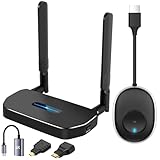
Wireless HDMI Transmitter and Receiver 4K Kit, Full HD...
- 【SCREEN MIRRORING VIDEO/AUDIO to BIG SCREEN】 Wireless hmdi transmitter and receiver supports...
- 【MORE ADAPTATIONS】Additional features include a mini adapter and a portable USB C to HDMI...
This kit takes the broadest compatibility approach, handling HDMI and VGA sources alongside phone and tablet pairing over Wi-Fi.
That flexibility suits a setup mixing sources rather than dedicating the kit to one camera. A laptop, a console, a DSLR, and a phone all connect through the same receiver.
Phone and tablet support works without a plug in adapter, pairing over a wireless connection instead. For a streamer using a phone as a second angle, that removes a cable entirely.
Range is one hundred sixty five feet or fifty metres, which covers a studio comfortably. 1080P at sixty hertz is the output resolution.
Included adapters cover USB-C to HDMI at 1080p60 and 4K HDMI, suiting MacBook, iPad, and similar devices. That inclusion saves separate purchases.
The receiver requires a Type-C cable and a 5V 2A charger, which is worth knowing before planning a portable setup. That is not included in every configuration.
A capture card sits between receiver and computer for OBS, since there is no UVC output on this kit.
What I Love:
- Handles HDMI and VGA sources alike
- Phone and tablet pair without a plug in adapter
- USB-C and 4K HDMI adapters included
- Suits a setup mixing several different sources
- 165 foot range covers a full studio
| Specification | Detail |
|---|---|
| Output | 1080P at 60Hz |
| Range | 165ft / 50M |
| Inputs | HDMI and VGA |
| Device Support | Laptop, PC, console, DSLR, phone |
| Included | USB-C to HDMI and 4K HDMI adapters |
| Receiver Power | Type-C, 5V 2A required |
| OBS Route | Capture card required |
My verdict after testing: the mixed source option, sensible when several different devices need to reach one receiver.
Frequently Asked Questions
Can OBS Use A Wireless Camera Directly?
Yes, through two different routes. A receiver with UVC output appears in OBS as an ordinary video capture device with no additional hardware or drivers required.
The second route uses OBS and its Media Source, entering an RTSP address from a WiFi IP camera. That pulls the stream over your network with no capture hardware at all.
Everything else needs a capture card between the wireless receiver and your computer. That works perfectly well and simply adds a small purchase and a little latency to the chain.
How Much Latency Is Acceptable For Streaming?
Under 100ms end to end is comfortable and viewers will not notice it. Between one hundred and three hundred milliseconds becomes perceptible in careful comparison but remains usable.
Above roughly three hundred milliseconds, lip sync problems become visible to viewers and your video starts looking dubbed. That is the point where a setup stops being suitable for a presenter.
Test yours by filming a running stopwatch and comparing the number against the OBS preview. Two minutes of testing tells you far more than any manufacturer figure.
Is The RTSP Route Good Enough For Live Streaming?
For secondary angles, overhead shots, workbench views, and room cameras, comfortably yes. Several hundred milliseconds of delay is invisible when nobody is speaking directly to camera.
For a presenter’s face it is not suitable, because the lip sync mismatch becomes obvious to viewers. Use a wireless HDMI kit for that instead.
Many streamers mix both routes, running an RTSP camera for a wide room shot and a low latency kit for the main angle. That combination keeps costs down where delay does not matter.
Do I Need A Capture Card For A Wireless Camera?
Only if your wireless receiver lacks UVC output, which most do. The card converts HDMI into a signal OBS recognises as a video capture device.
Kits with UVC built in skip that stage entirely, saving both the purchase and the small latency the conversion adds. Check for UVC mentioned explicitly in the specification.
RTSP cameras need no capture card at all, since the stream arrives over your network rather than through a video connection. That is the main cost advantage of that route.
What Resolution Should I Stream At?
1080p60 is the practical target for almost everyone. Most platforms cap there or transcode down anyway, and the bandwidth saving against 4K is substantial.
Your chain is limited by its weakest component, so a 4K camera through a 1080p capture card gives you 1080p. Match the chain rather than overspending at one point.
Check the frame rate at your chosen resolution too. Several cheap devices manage 4K only at thirty frames, dropping to 1080p for sixty, and sixty frames matters more than resolution for smooth motion.
How Far Will A Wireless Video Link Actually Reach?
Advertised ranges assume clear line of sight with nothing in between, which no real setup has. Walls, people, and competing networks all cut those figures substantially.
A kit claiming three hundred feet often manages thirty through a wall, which is still ample for a studio or a room. Do not pay a premium for range you cannot use.
5GHz operation resists interference better than 2.4GHz, and dual band devices let you switch when one becomes congested. In a venue with many networks that flexibility prevents dropouts.
Will A Wireless Camera Slow Down My Stream Upload?
An RTSP camera does compete for network capacity, since the stream crosses the same network your upload uses. On a constrained connection that matters.
Wireless HDMI kits do not, because the transmitter and receiver pair directly with each other rather than joining your network. Your upload bandwidth stays untouched.
If your connection is tight, favour the direct pairing route or connect your RTSP camera to a separate network. Lowering the camera’s bitrate also helps considerably.
Can I Use A Phone As A Wireless Camera For OBS?
Yes, and several applications turn a phone into a network camera OBS can pull from over Wi-Fi. Image quality from a modern phone is genuinely good.
The latency profile resembles the RTSP route, running a few hundred milliseconds through network buffering. That suits secondary angles rather than a main presenter shot.
Some wireless kits also pair with phones directly, and one of the kits here supports that without a plug in adapter. That route generally performs better than an application does.
What Powers A Wireless Transmitter During A Stream?
Options vary considerably and this is easy to overlook when comparing prices. Some accept NP-F batteries, some USB-C, and some only a DC input.
NP-F compatibility is genuinely valuable because those batteries run for hours and many people already own them from camera work. USB-C lets an ordinary power bank do the job.
Check both transmitter and receiver, since they frequently differ. Discovering the receiver needs a wall socket after planning a portable setup is a common and avoidable frustration.
Final Thoughts
After testing all three routes, the decision comes down to one question about your camera. Ask what it is pointed at, because that determines how much delay you can accept.
If it is a face, buy the BovBox UVC Wireless Kit. Its UVC output removes the capture card from your chain entirely, which cuts both cost and latency in one move.
If it is a workbench, a room, or a second angle nobody is speaking from, the Reolink Duo 2 WiFi and the RTSP route costs a fraction as much and works fine.
If you already own a camera with HDMI out, add a transmitter and the Budget HDMI Capture Card rather than replacing anything. Whatever you choose, a cheap wireless camera for obs setup lives or dies on latency, so film a stopwatch and check yours before your first live stream.